
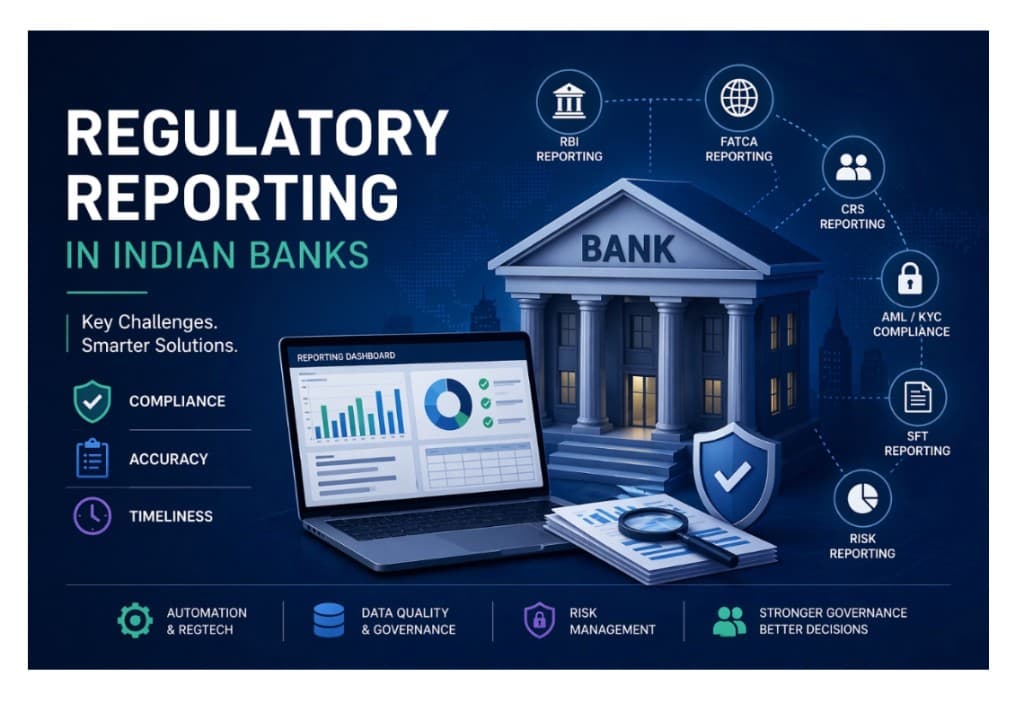
Overview
The Indian banking sector operates in one of the most regulated environments globally. With the rapid growth of globalization, digital banking and cross-border transactions, regulatory reporting has become more complex than ever. Banks in India must comply with multiple regulatory frameworks such as RBI guidelines, FATCA (Foreign Account Tax Compliance Act), CRS (Common Reporting Standard), AML (Anti-Money Laundering), SFT reporting and Ind AS based norms.
While regulatory reporting ensures transparency, financial stability and prevention of fraud, it also presents significant operational, technological and compliance challenges for banks.
Understanding Regulatory Reporting in India
Regulatory reporting is the process through which banks submit financial, transactional and customer-related data to various regulatory authorities like the Reserve Bank of India (RBI), Income Tax Department, Central Board of Direct Taxes (CBDT) and global authorities (international regulatory bodies).
Key Regulatory Reporting Frameworks
Banks in India must adhere to a wide range of reporting requirements, such as:
- RBI Regulatory Returns — Periodic financial and operational reporting to the RBI
- FATCA Reporting — Reporting of accounts linked to U.S. taxpayers (under the Internal Revenue Service (IRS))
- CRS Reporting — Global information exchange for tax transparency (under the Organisation for Economic Co-operation and Development (OECD))
- Basel III Risk Reporting — Monitoring capital adequacy and risk exposure
- AML/KYC Reporting — Prevention of money laundering and fraud
- SFT (Statement of Financial Transactions) — Reporting specified high-value transactions
Global Compliance: FATCA & CRS
India has adopted international frameworks like FATCA and CRS to:
- Combat tax evasion
- Enable automatic exchange of financial information between countries
- Strengthen global financial transparency
These frameworks require banks to identify and report foreign account holders and cross-border financial activities.
The Challenge Ahead
Although regulatory reporting strengthens the financial ecosystem, it also brings challenges such as:
- Managing large volumes of data
- Ensuring data accuracy and consistency
- Adapting to frequent regulatory changes
- Handling complex reporting requirements
Future Trends in Regulatory Reporting
| Trend | Key Focus | Description / Impact |
|---|---|---|
| RegTech Adoption | - AI & automation - Smart compliance tools | Banks are increasingly adopting technology-driven solutions to automate reporting processes, reduce costs and improve accuracy. |
| Real-Time Reporting | - Continuous data flow - Instant submissions | Regulatory reporting is shifting from periodic to real-time reporting, enabling regulators to monitor risks more effectively. |
| Increased Regulatory Scrutiny | - More audits - Strict penalties | Regulators are becoming more stringent, requiring banks to maintain high levels of accuracy, transparency and governance. |
| Data Standardization | - Common formats - Global alignment | Standardized data formats across jurisdictions simplify reporting and improve global data exchange under frameworks like FATCA and CRS. |
Major Regulatory Reporting Challenges
-
Data Quality and Accuracy issues
One of the biggest challenges in regulatory reporting is ensuring accurate and complete data.- Missing or incorrect TIN (Tax Identification Number)
- Outdated account holder information
- Incorrect classification of accounts
Even a small error can lead to penalties or reputational damage. Many banks struggle because account holder data is often incomplete or not updated regularly.
-
Fragmented Systems and Data Silos
Banks operate on multiple systems:
- Core Banking Systems
- CRM platforms
- Risk systems
- Treasury systems
These systems often do not communicate effectively, leading to:
- Data duplication
- Inconsistent reporting
- Manual reconciliation efforts
Fragmented data architecture is a key reason for reporting inefficiencies.
-
Heavy Reliance on Manual Processes
Many banks still depend on:
- Excel-based calculations
- Manual data adjustments
- End User Computing (EUC) tools
While flexible, these methods are:
- Error-prone
- Difficult to audit
- Risky for compliance
Manual interventions increase the chances of misreporting and regulatory scrutiny.
-
Frequent Regulatory Changes
The regulatory environment is constantly evolving:
- RBI circular updates
- Global compliance changes (OECD, Basel)
- Amendments in FATCA/CRS rules
For example, RBI has had to consolidate thousands of circulars into master directions to simplify compliance.
Banks must continuously update:
- Systems
- Policies
- Reporting formats
This creates a constant operational burden.
-
Complex FATCA & CRS Compliance
FATCA and CRS reporting involve:
- Identifying reportable accounts
- Collecting self-certifications
- Classifying tax residency
Challenges include:
- Missing self-certifications
- Misclassification of accounts
- Differences between FATCA and CRS rules
Even well-established systems can fail due to complexity and interpretation issues.
-
Data Privacy and Security Concerns
Regulatory reporting involves sensitive customer data:
- Financial details
- Tax information
- Personal identification
Banks must balance:
- Compliance requirements
- Data privacy laws
Any data breach can lead to:
- Legal consequences
- Loss of customer trust
Security remains a critical challenge in cross-border reporting.
-
High Compliance Costs
Regulatory reporting requires:
- Advanced IT systems
- Skilled manpower
- Continuous monitoring
Costs increase due to:
- System upgrades
- Regulatory changes
- Audit and compliance requirements
FATCA/CRS compliance alone can significantly increase operational costs due to additional onboarding and verification processes.
-
Lack of Skilled Resources
Banks often face:
- Shortage of regulatory experts
- Limited understanding of global compliance
- Dependency on key individuals
Upskilling employees is a critical but challenging due to evolving regulations.
-
Governance and Control Weaknesses
Regulators expect banks to demonstrate:
- Strong governance frameworks
- Audit trails
- Data lineage
However, many banks lack:
- Proper documentation
- Control mechanisms
- Standardized processes
Weak governance increases regulatory risk and scrutiny.
-
Timeliness of Reporting
Banks must submit reports: Daily, Monthly, Quarterly and Annually.
Delays can occur due to:
- Data aggregation issues
- System inefficiencies
- Manual validations
Timely reporting is critical, as delays may lead to penalties.
-
Regulatory Scrutiny and Penalties
Regulators like RBI have increased enforcement actions.
In FY2025 alone, penalties were imposed on hundreds of entities for non-compliance. This highlights:
- Increasing regulatory pressure
- Need for accurate reporting
- Importance of compliance culture
-
Integration with Global Standards
Indian banks operating globally must comply with:
- Basel III
- IFRS
- FATCA/CRS
Aligning domestic and international requirements creates:
- Complexity
- Duplication of work
- Reporting inconsistencies
Key Impact Areas
Regulatory reporting challenges affect:
-
Operational Efficiency
Manual processes reduce efficiency and increase workload. -
Risk Management
Poor reporting leads to incorrect risk assessment. -
Reputation
Errors or penalties damage bank credibility. -
Financial Costs
Compliance failures result in fines and remediation costs.
Solutions & Best Practices for Regulatory Reporting
| Area | Key Actions | Description or Business Value |
|---|---|---|
| Data Governance Framework | - Single source of truth - Data lineage & ownership - Data quality checks | Establishing a strong data governance framework ensures that all regulatory reports are based on accurate, consistent and reliable data. It reduces errors, improves audit readiness, and builds trust with regulators. |
| Automation & Technology (RegTech) | - Implement RegTech tools - Reduce manual work - AI-based anomaly detection | Automation minimizes human errors and speeds up reporting. Advanced technologies like AI help detect anomalies, improve accuracy and ensure compliance with evolving regulations. |
| Centralized Reporting Systems | - System integration - Remove data silos - Enable real-time reporting | A centralized platform integrates multiple banking systems, ensuring seamless data flow. This improves efficiency, reduces duplication and enables faster decision-making. |
| Strong Internal Controls | - Audit trails - Approval workflows - Monitoring mechanisms | Robust internal controls ensure transparency and accountability in reporting. They help banks track changes, prevent fraud, and meet regulatory expectations effectively. |
| Continuous Training & Skill Development | - Regular training - Regulatory updates - Certification programs | Continuous learning ensures that employees stay updated with changing regulations. Skilled teams reduce compliance risks and improve reporting quality. |
| Periodic Reviews & Audits | - Internal audits - Data validation - Compliance reviews | Regular reviews help identify gaps early and ensure corrective actions. This strengthens compliance posture and reduces the risk of penalties. |
| Customer Data Management | - KYC updates - Digital onboarding - Automated validation | Accurate customer data is critical for FATCA/CRS reporting. Efficient data management ensures proper classification and reduces reporting errors. |
Final Conclusion
Regulatory reporting in Indian banks is no longer just a compliance function and it is a strategic priority. With increasing regulatory expectations, global standards and technological advancements, banks must transform their reporting frameworks. The key lies in:
- Improving data quality
- Leveraging technology
- Strengthening governance
Banks that proactively address these challenges will not only ensure compliance but also gain a competitive advantage in the evolving financial landscape.